
English · Nederlands

Pricing AI features on tokens ties your revenue to the one input in your product that is getting cheaper fastest. It looks prudent. It is a trap that closes slowly.
Why token pricing feels right
When a SaaS company adds AI, the first price model usually comes from finance. Tokens are the one cost you can measure on day one. Wrap them in credits, add a margin, and every sale looks safe.
The problem is the trend line. At a fixed level of capability, LLM API prices have fallen between 9x and 900x per year depending on the task (Epoch AI). Others put the decline nearer 10x a year (a16z). Whichever figure you take, you are anchoring your price to a commodity in free fall.
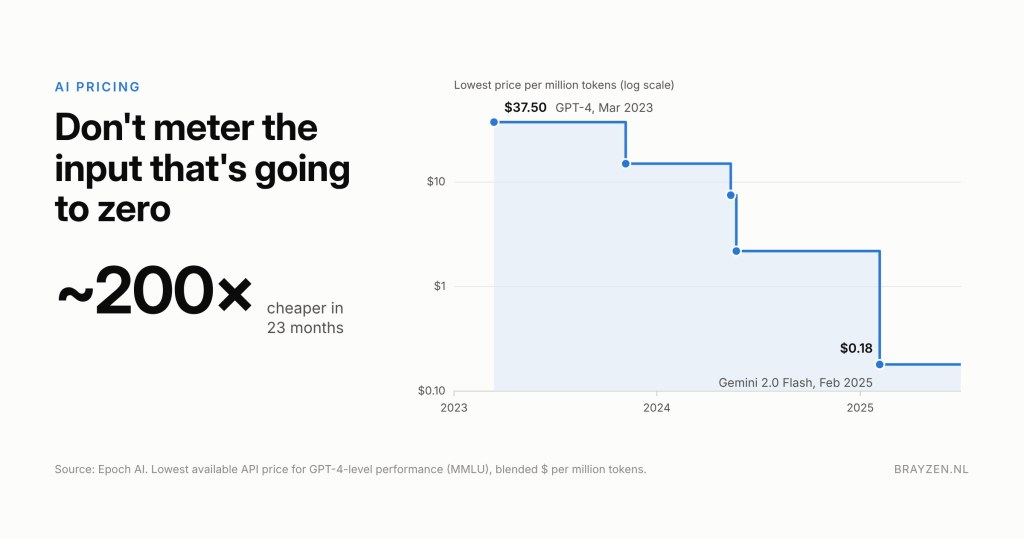
That alone is a margin story. Two structural shifts turn it into a strategy problem.
Break one: from features to agents
Today’s AI features are mostly incremental. A user asks one question, the system makes one model call, you count the tokens. Cost and use move together, so a per-question credit feels fair.
Agents break that link. One request fans out into many model calls, retrievals and tool invocations, decided by the agent at run time. The same task can cost ten times more on Tuesday than on Monday, depending on the document, the path the agent takes and how often it checks its own work.
Three consequences follow:
- Cost becomes bursty and unforecastable. The customer cannot predict the bill, so procurement cannot approve it.
- Cost stops tracking value. A hard case may burn many credits for an answer worth little; a simple one may save a day of work for a fraction of a cent.
- The meter punishes the product working well. An “always on” agent that monitors, drafts and acts in the background is the whole promise. Meter its tokens and you bill the customer most precisely when the agent is doing its job.
If your roadmap says agents, a token spine is already obsolete.
Break two: the compute moves to the customer
The second shift is quieter. Large enterprises increasingly refuse third-party AI on sensitive data. They approve a model, host it inside their own perimeter or sovereign cloud, and ask vendors to plug into it. “Bring your own model” is moving from a niche request to a procurement checkbox, especially in regulated and public-sector buying.
When that happens, your token cost goes to roughly zero. The customer pays for the inference. Yet you still deliver the domain logic, the workflow, the data and the audit trail that make the answer useful.
A price built on tokens now meters the one input you no longer supply, and ignores everything the customer actually buys from you. Your best, most security-conscious accounts become the ones your model cannot price.
What the customer is actually paying for
If not tokens, then what? It is tempting to answer “our data”. Be careful. Much domain data is public or soon will be, and the part that counts is usually recent, not twenty years of archive.
In my experience the defensible value of a vertical SaaS product with AI sits in three places:
- Proximity to the live process. The work flows through your platform, so you see what is happening now. That continuous context is what a generic assistant cannot get by pasting a document into a chat window.
- The system of record. Your output carries evidentiary weight: it is logged, attributable and auditable. In compliance-heavy work, that matters more than the cleverness of the answer.
- The network. If both sides of a market work on your platform, every transaction improves what you can tell the next customer.
On top of that sits the orchestration your engineers already write: prompts, retrieval guardrails, checks, harnesses for agents. Amortised over thousands of customers, that is real value. None of it is measured in tokens.
What to do instead: two layers
You do not have to pretend cost does not exist. Split it into two layers and keep them apart.
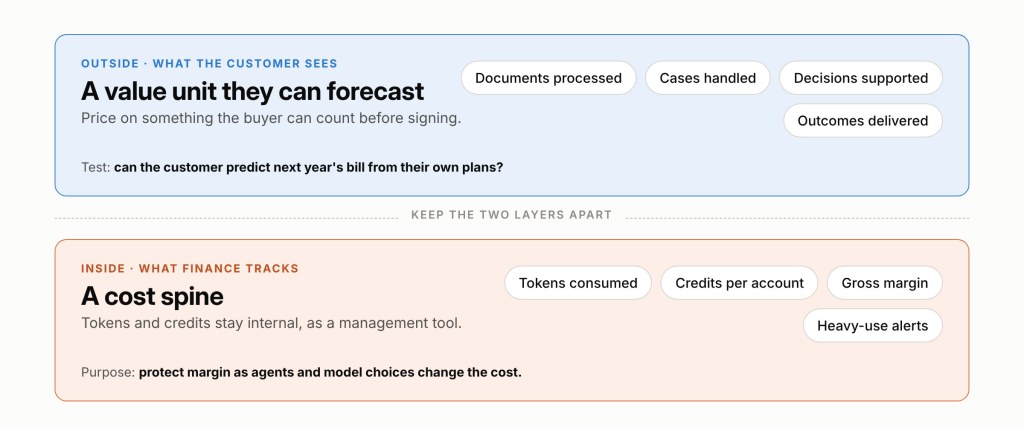
Inside: a cost spine. Use credits or tokens internally to track consumption, protect margin and spot heavy accounts. Finance needs this. Customers never need to see it.
Outside: a value unit the customer can estimate. Price on something the buyer can count before signing: documents processed, cases handled, decisions supported, outcomes delivered. The test is simple: can the customer predict next year’s bill from their own plans? If not, procurement will stall it or discount it.
The market is already moving this way. Salesforce’s Agentforce started at $2 per conversation, moved new buyers to Flex Credits at $0.10 per agent action, and now also sells a $2 per resolved conversation and per-user licences. Notably, each action is metered regardless of how many tokens it uses (Macha’s breakdown of the Salesforce rate card). Fin, formerly Intercom and now part of Salesforce, charges $0.99 per resolved conversation and nothing when it fails (Voiceflow).
The spectrum looks like this:
| Unit you charge | Customer can forecast it | Tracks the value delivered | Who carries cost risk |
|---|---|---|---|
| Tokens | No | No | Customer |
| Agent actions | Partly | Partly | Shared |
| Conversations or tasks | Yes | Partly | Vendor |
| Outcomes (resolved, decided, won) | Yes, if well defined | Yes | Vendor |
The further down the table, the more of the cost risk you carry, and the more you can charge for. Outcome pricing has its own trap: the definition of an outcome becomes the contract. Write it so a buyer would accept it in a dispute.
There is a useful precedent outside AI. Analytics vendors have long priced on server calls, a unit the customer’s own traffic data predicts. The same principle applies: the customer must be able to map usage to spend before they buy, not after the invoice arrives.
Margin is a buffer, not a strategy
Many AI features launch with gross margins in the 90s on token cost. That is fine as a starting point. A wide margin buys you time to learn how customers really use the feature, before you know what to charge.
Do not mistake it for a moat. If your price is visibly a multiple of token cost, a competitor only has to divide. Token prices keep falling, so the multiple keeps growing, and the race to zero starts with whoever undercuts first. The protection is to price on value from the start, so falling costs widen your margin instead of inviting a price war.
Two practical rules help:
- Never cut model quality to save cost on a revenue feature. If a customer gets a better answer by pasting the same document into a free chatbot, you have no product.
- Do not publish a per-credit price you have not calibrated. The first number you show becomes the anchor for years. Show the customer a unit they understand and keep the cost per credit internal.
The short version
Tokens are the right way to manage your cost and the wrong way to set your price. Agents will make token cost unpredictable, customer-hosted models will make it disappear, and the price per token will keep falling either way. Build a cost spine for finance, give the customer a value unit they can forecast, and let falling inference costs become your margin rather than your competitor’s opening.
If you are designing AI pricing for a SaaS platform and want to test your model against these breaks, get in touch.
Related reading
- Cloud Licensing (2011): the same tension between simple, flexible and predictable pricing, one technology cycle earlier.
- T-Mobile Buddy Finder (2011): “how can I bill this per minute?”, the original version of the token question.